Black Friday is on — deals until 30 NovemberSee the deals
Teltonika

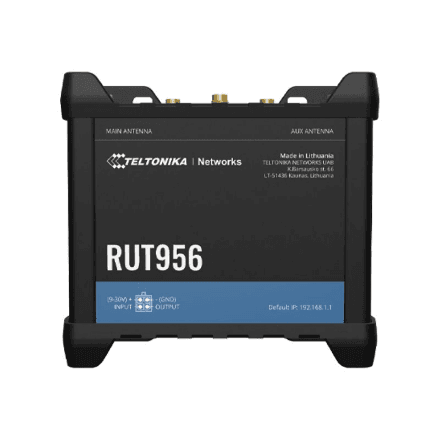
Teltonika RUT956 industrial 4G router, Wi-Fi 4, 4 × LAN, GNSS, USB

The Teltonika RUT956 is an industrial 4G router that works on 4G networks and falls back to 3G and 2G when needed. It offers Wi-Fi 4 (802.11n), four LAN ports, a USB 2.0 port and a GNSS antenna connector. The software is OpenWrt-based RutOS, which keeps configuration flexible.

  • Wi-Fi: 802.11n (Wi-Fi 4), no MU-MIMO
  • Mobile internet: 2G/3G/4G
  • LAN ports: 4 × RJ-45 10/100 Mbit/s
  • Antenna connectors: 2 × SMA LTE, 2 × RP-SMA Wi-Fi, 1 × SMA GNSS
  • USB: 1 × USB 2.0
  • Software: RutOS (OpenWrt-based Linux)
  • Weight: 0.46 kg

Description

4G connectivity with 3G and 2G fallback

The RUT956 connects to the internet over the mobile network. 4G is the main mode, but the router also supports 3G and 2G, so in places without 4G coverage the connection stays up, even if more slowly. Two SMA connectors serve the mobile link, so external antennas can be fitted and placed wherever reception is strongest.
Wi-Fi 4 for sensors and a service laptop

The wireless network runs on 802.11n, also known as Wi-Fi 4. It is a simpler and older standard than Wi-Fi 5 and does not support MU-MIMO, but in industrial use its role is usually modest: connecting sensors, a terminal or a technician's laptop. Two RP-SMA connectors are provided for the Wi-Fi antennas, so they too can be placed where they work best.

Four ports for wired devices

The router has four RJ-45 ports at 10/100 Mbit/s. They are not gigabit, but for industrial controllers, cameras, payment terminals and other devices that send small amounts of data, 100 Mbit/s is plenty. The port speed also matches the typical throughput of a mobile 4G link well, so the ports do not become a bottleneck.

USB 2.0 and GNSS

The router has one USB 2.0 port; the manufacturer does not specify which USB devices it supports. A separate SMA connector is reserved for a GNSS antenna. GNSS is the umbrella term for satellite navigation systems such as GPS and Galileo. Location data helps keep track of devices at remote sites or on mobile machinery.

RutOS: the flexibility of Linux

The RUT956 runs Teltonika RutOS, based on the open-source OpenWrt Linux. OpenWrt is widely used in networking equipment and familiar to many administrators. The Linux foundation means the router can be configured precisely to match your own network rules. The unit weighs 0.46 kg, so it puts no strain on a control cabinet or its mounts.

Who this router is for

Industrial and energy companies connecting remote equipment and control cabinets; integrators building remote monitoring and data collection solutions; installers of retail and automation systems for whom 100 Mbit/s ports are enough; and businesses that need a dependable mobile connection even where coverage is weak.

Specifications

General

BrandTeltonika
EAN4779051840175

Ports

Ethernet LAN (RJ-45) ports4
Ethernet LAN data rates10/100 Mbit/s
USB ports quantity1x USB 2.0

Connectivity

Antenna type2 x SMA for LTE, 2 x RP-SMA for WiFi, 1 x SMA for GNSS
Mesh SupportNo
Mobile Broadband2G/3G/4G
MU-MiMONo
Wi-Fi band802.11n

Software & security

Software typeRutOS (OpenWrt based Linux OS)

Dimensions & weight

Net weight0.46 kg

Questions & answers

Does the router support 5G?

No. According to the manufacturer, the RUT956 works on 2G, 3G and 4G networks. For 5G, Teltonika offers separate models such as the RUTX50.

Are the LAN ports gigabit?

No, the ports run at 10/100 Mbit/s. For industrial equipment and a 4G link this is usually enough.

Can the router determine its location?

The router has an SMA connector for a GNSS antenna, so satellite navigation reception is provided for. Accuracy depends on the antenna and where it is mounted.

Are antennas included?

The manufacturer lists only the antenna connectors (2 × SMA, 2 × RP-SMA, 1 × SMA) and does not specify whether antennas are included.